Organisational Carbon Footprint Report 2025: Bauder’s Long-Term Carbon Strategy is Delivering Results
Sustainability
Bauder's approach to carbon reduction has been guided by a clear principle: measure performance, set meaningful targets, and make informed decisions based on evidence. Our latest Organisational Carbon Footprint Report shows how this strategy has contributed to a 42% reduction in net Scope 1 and Scope 2 emissions since reporting began, with performance remaining approximately 18% ahead of forecast reductions.
In 2019, we established our organisational carbon footprint baseline and adopted a carbon reduction plan aligned with the Science Based Targets initiative (SBTi) SME pathway. This provided a framework for understanding where emissions were generated, identifying opportunities for improvement and setting long-term reduction targets.
Since then, the business has focused on reducing our scope 1 & 2 emissions through practical operational changes, particularly in relation to company vehicles, energy use, and buildings. The latest Organisational Carbon Footprint Report shows that these actions are delivering measurable results while supporting continued business growth.
Using targets to support decision-making
Carbon reduction targets are most effective when they inform business decisions. For Bauder, the SBTi pathway has provided clear milestones and performance indicators that have helped shape investment priorities across the organisation.
This has been particularly important when evaluating projects such as:
- the electrification of company vehicles
- the transition away from fossil fuel heating systems
- investment in renewable energy generation
Having defined reduction targets has made it easier to assess the long-term environmental benefits of these projects and build a business case for implementation.
Today, Bauder remains committed to achieving net zero Scope 1 and Scope 2 emissions by 2035 and net zero Scope 3 emissions by 2045. These targets continue to shape our approach to operational improvement and future investment.
Reducing emissions through electrification
A significant proportion of Bauder's emissions reductions have been achieved through the electrification of vehicles and buildings.
As company vehicles are replaced, electric vehicles are introduced wherever practical. Supporting infrastructure, including workplace charging facilities, has been expanded to help employees make the transition to electric vehicles.
The same approach has been applied to our buildings. The new Gateway 14 warehouse facility has been designed to operate using electricity rather than fossil fuels and includes rooftop solar PV generation.
In addition, the renovated Landseer Road UK headquarters (re-opening in September) includes:
- air source heat pumps
- additional solar generation capacity
- increased electric vehicle charging provision
These projects form part of a long-term strategy to reduce operational emissions and improve energy efficiency across the business.
Performance against the 2019 baseline
The most meaningful measure of progress remains performance against the original 2019 benchmark.
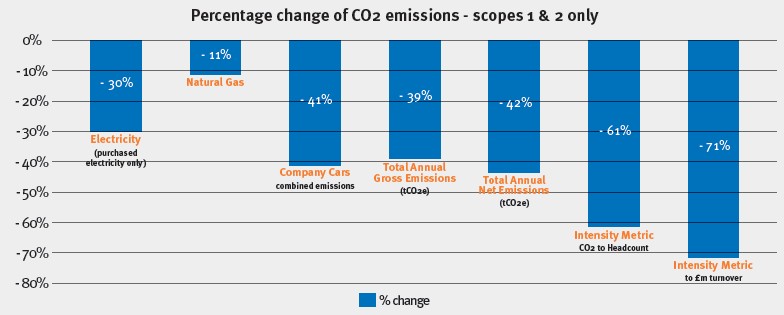
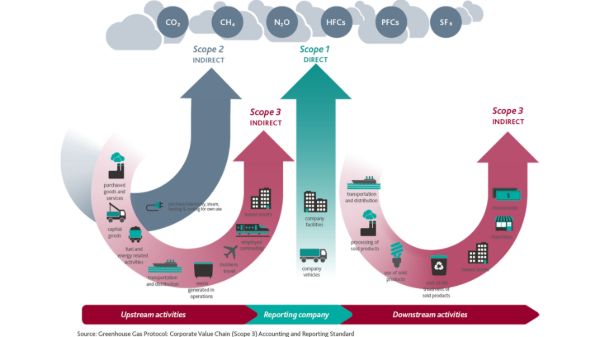
Since reporting began, Bauder has reduced its net Scope 1 and Scope 2 carbon emissions by 42% (Figure1). Scope 1 covers direct operational emissions (such as fuel used in company vehicles) while Scope 2 relates to indirect emissions from purchased energy (such as electricity).
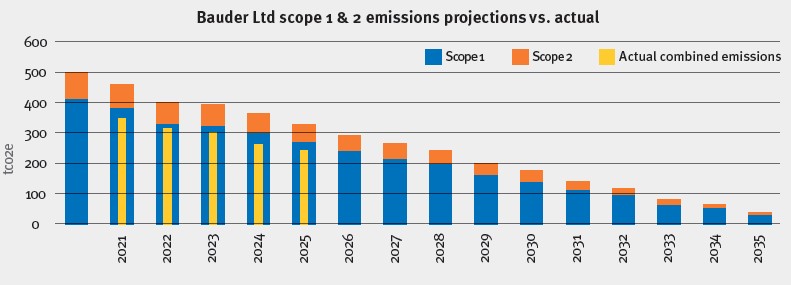
The business is also performing ahead of the reduction trajectory established through its carbon reduction plan and remains approximately 18% ahead of forecast reductions, as shown in Figure 2, below.
Company vehicle emissions have reduced by 41% compared with 2019. This has been achieved despite growth in the vehicle fleet and an increase in overall miles travelled, demonstrating the impact of fleet electrification on reducing operational emissions.
Energy-related emissions have also decreased. Electricity consumption has reduced compared with the baseline year, while natural gas use has fallen significantly as low-carbon heating systems have been introduced. Throughout the reporting period, all purchased electricity has come from renewable energy sources.
Reducing emissions while growing the business
An important outcome of the carbon reduction programme is that emissions have fallen during a period of business growth.
Since 2019, Bauder has increased both employee numbers and turnover while continuing to reduce operational emissions. This is reflected in the company's intensity metrics, which measure emissions relative to headcount and revenue. Both indicators have improved significantly since the baseline year.
This demonstrates that growth does not need to result in higher emissions. Through targeted investment and long-term planning, it is possible to reduce absolute carbon emissions while expanding business activity.
Equally, our flat roof systems keep buildings warm and dry, whilst our green roof and solar PV provide a wide range of environmental benefits and reduce carbon emissions in use. Delivering more of these solutions, whilst reducing our impact, is something Bauder is very proud of as a company.
Expanding Scope 3 reporting
While Scope 1 and Scope 2 emissions continue to reduce, Scope 3 emissions (i.e., indirect value-chain emissions, such as from product transportation) remain a key area of focus.
Current reporting includes emissions associated with employee commuting, business air travel and operational waste. During 2025, Scope 3 emissions increased, primarily because of higher levels of business travel.
Improving the quality and breadth of Scope 3 reporting is an important next step. Bauder is already working to expand reporting boundaries to include additional emissions sources, including purchased goods and services, transportation, and distribution activities, and a wider range of business travel data.
Although these activities may increase the reported organisational footprint as more data becomes available, they will provide a more complete understanding of the company's overall environmental impact and help identify further opportunities for reduction.
What next? Bauder’s focus for the years ahead
The findings of the 2025 report show that Bauder's long-term approach to carbon management is delivering results.
Progress against the 2019 baseline demonstrates the value of establishing clear targets and aligning investment decisions with those objectives. Electrification of vehicles and buildings, renewable energy generation, and improvements in operational efficiency have all contributed to significant reductions in emissions.
Looking ahead, the focus remains on continuing this trend. Priorities include completing further electrification projects, reducing emissions associated with business travel, improving Scope 3 reporting, and working more closely with suppliers to increase transparency across the value chain.
Carbon reduction is an ongoing process rather than a single milestone. By maintaining a consistent approach and continuing to improve the quality of data and reporting, Bauder is well positioned to make further progress towards its long-term net zero commitments.
Key takeaways
- Scope 1 and 2 emissions have fallen by 42% since Bauder's 2019 baseline.
- Bauder remains ahead of its SBTi-aligned carbon reduction pathway.
- Electrification of vehicles and buildings is driving emissions reductions.
- Company vehicle emissions are down 41% despite business growth.
- Carbon emissions per employee and per £m turnover continue to improve.
- Scope 3 emissions have increased, largely due to business travel.
- Expanding Scope 3 reporting and reducing travel emissions are key next steps.
- Bauder’s focus remains on continual improvement while progressing towards net zero targets.
Further Reading
Carbon Reduction in Construction: Understanding Scope 1,2 and 3 Emissions