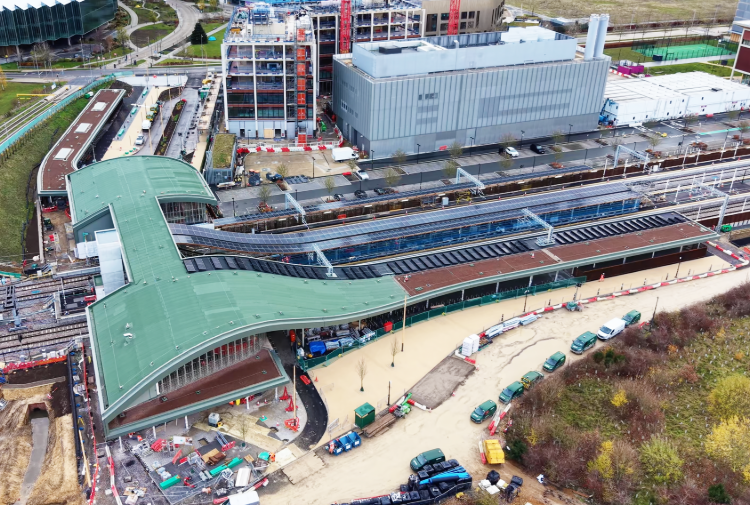
Cambridge South Station
Winner of the Reinforced Bitumen Membranes category at The NFRC UK Roofing Awards Roofing in London on May 8th – submitted by Hambro Roofing Ltd.
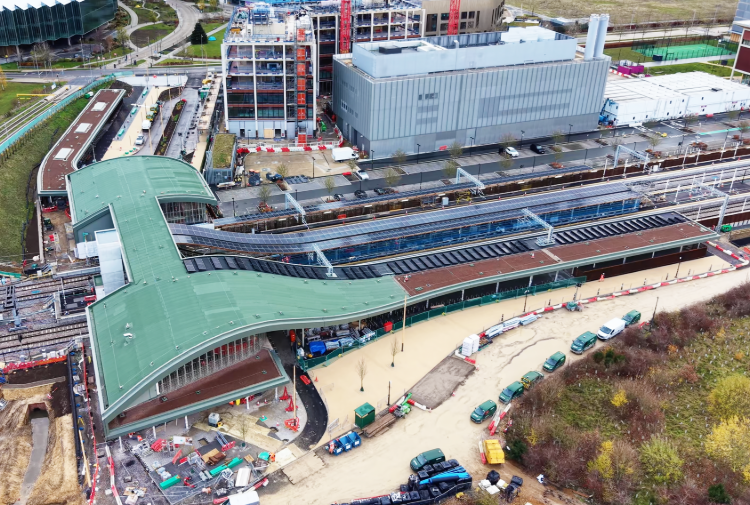
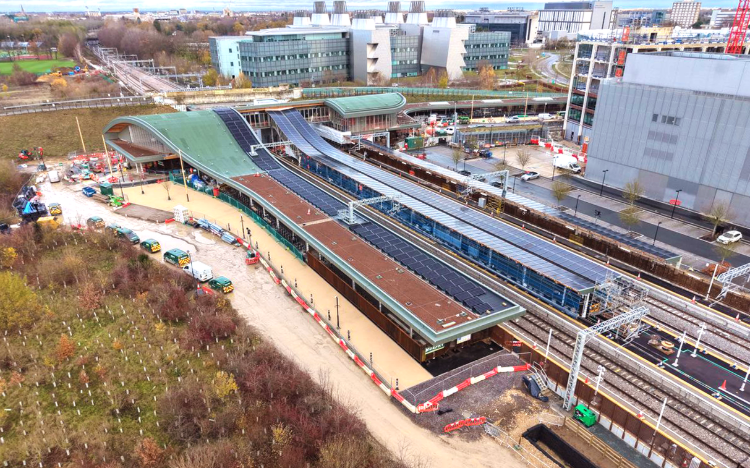
Cambridge South Station, a major new rail development featuring large scale green roofing across a distinctive curved roof, demanded a robust waterproofing solution and carefully coordinated installation.
Synopsis
Cambridge South Station is a major new rail development serving the Cambridge Biomedical Campus and surrounding community, improving access for thousands while supporting sustainable travel and long term growth in the region.
The station’s sweeping curved roof sets the project apart, creating an ambitious roofscape where the scale and geometry turned the roofing works into one of the most demanding elements of the build. Alongside this, the incorporation of extensive green roofing was a key part of the project’s environmental ambition, with the roof designed not only as a protective element but as an active contributor to biodiversity and long term sustainability.
Green roof areas were integrated across both flat and sloping zones, introducing further complexity and placing increased demands on the waterproofing build up. A reinforced bitumen membrane system offered the flexibility and durability required to accommodate the complex design.
Bauder building board
Project | Cambridge South Station |
Location | Trumpington, Cambridge |
Project type | New Build |
Roof size | 4333 m2 |
Main contractor | J Murphy & Sons Ltd |
Approved contractor | Hambro Roofing Ltd |
The specification
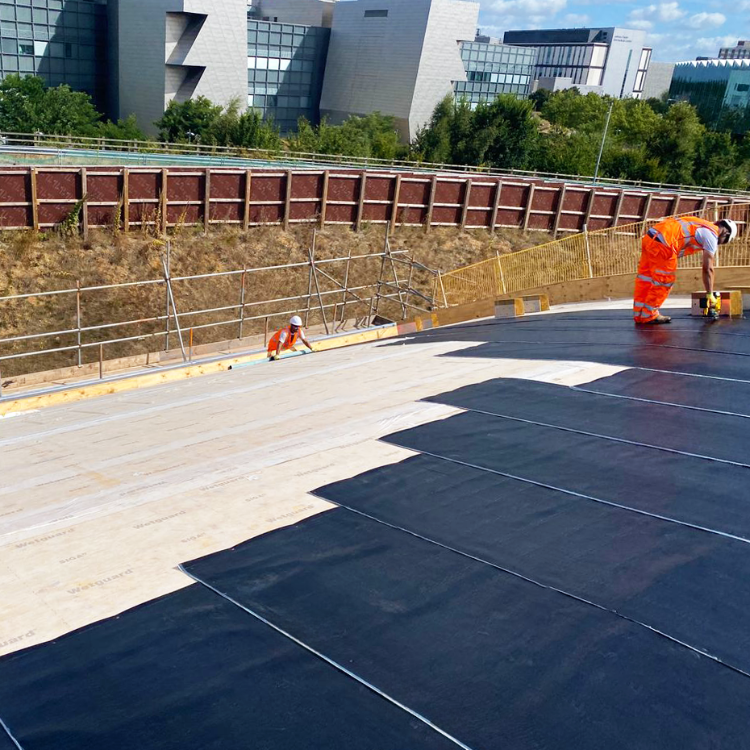
The roofing solution was delivered using a Bauder Total Green Roof System (BTGRS), incorporating a reinforced bitumen membrane. The build-up comprised a combination of BauderPIR flat and tapered insulation together with Rockwool tapered insulation, designed to achieve accurate falls to drainage across the complex configuration while maintaining consistent thermal performance. Thermal calculations were undertaken at design stage to ensure the roof build-up achieved the required U value.
Due to the sloped roof profile and varying gradients, additional measures were required to provide long term stability. Retention plates were installed at regular, pre determined intervals, mechanically fixed through the insulation and coordinated with the reinforced bitumen waterproofing layers to prevent slumping or creep on inclined sections.
The combination of high performance PIR insulation and non combustible Rockwool insulation provided an effective balance of thermal efficiency, fire performance and acoustic benefit, while remaining fully compatible with the reinforced bitumen system.
The build-up was completed with a BauderPLANT E bitumen capping sheet, providing a root-resistant surface to support the green roof areas, while also forming a separate base for photovoltaic installations. All components formed part of a fully compatible Bauder system, with waterproofing integrity confirmed through electronic leak detection testing prior to handover.
Project challenges
The challenges were driven primarily by the scale of the roof, its complex configuration, and the constraints of working within a live rail environment. Installation activities were required to be carefully coordinated, with defined work windows, exclusion zones and permit controls in place to ensure safety while maintaining programme continuity. A significant proportion of the roofing works were undertaken during night sessions, requiring enhanced lighting, reduced noise working methods and strict supervision to manage fatigue and maintain safe working practices.
The roof comprises a combination of flat areas, sloping zones, and varying gradients. This introduced complexity in setting out and sequencing, as well as ensuring the long term stability of both the insulation and reinforced bitumen waterproofing layers, particularly where green roofing was introduced on inclined sections. The retention plate system played a key role in addressing these risks, restraining the build-up across sloping areas and supporting long term dimensional stability.
Access and logistics added further pressure. Limited craneage opportunities and restricted loading areas meant materials were required to be carefully managed and distributed across the roof, with sequencing planned to maintain progress while protecting completed areas and managing manual handling risks.
All works were carried out adjacent to operational rail infrastructure, requiring close coordination with the wider construction programme and strict control of access, work windows and safety procedures. Enhanced safety measures were embedded into daily operations, including the use of weighted man anchors and full harness systems, allowing operatives to work safely without intrusive fixings that could compromise the waterproofing system.
Quality was maintained throughout the installation through Bauder approved detailing and robust site controls. Regular inspections were undertaken by site management and Bauder technical representatives, with hold points introduced at key stages including substrate preparation, insulation installation, retention plate fixing and felt application. Daily briefings, toolbox talks and ongoing supervision ensured operatives were fully aware of design intent, safety requirements and quality expectations. Drone technology was also used to assist inspections and progress reporting, reducing the need for working at height.
The result
The completed roof is a significant technical achievement, successfully bringing together a complex curved form and an extensive green roof despite the challenges presented by the project’s scale, geometry and live rail constraints.
The reinforced bitumen membrane system played a key role in enabling this outcome, providing a dependable base for the green roof build up across both flat and sloping areas. Its adaptability allowed the roof form to be constructed accurately and consistently, supporting the integration of green roofing without compromising buildability or finished quality.
Despite the logistical, access and operational challenges, the roofing works were delivered safely, on programme and within budget. The completed roof has been designed to allow safe future inspection and maintenance, with defined access routes, compatible anchor points and a robust waterproofing system capable of supporting long term performance.
The ambition of the roof design, combined with the successful delivery of the reinforced bitumen system, has been recognised through the project’s shortlisting as a finalist in the NFRC Roofing Awards for the Reinforced Bitumen Membrane category.